¶ Product
At a Glance
Module purpose: Product catalogue master — codes, categories, base/order/recipe units with conversions, location mapping, allergens, variants, and bulk import/export · Audience: Product Administrator, Purchaser, Store Keeper · Key entities/tables:tb_product,tb_product_category,tb_product_unit_conversion,tb_product_location,tb_product_variant· Sub-pages: 11
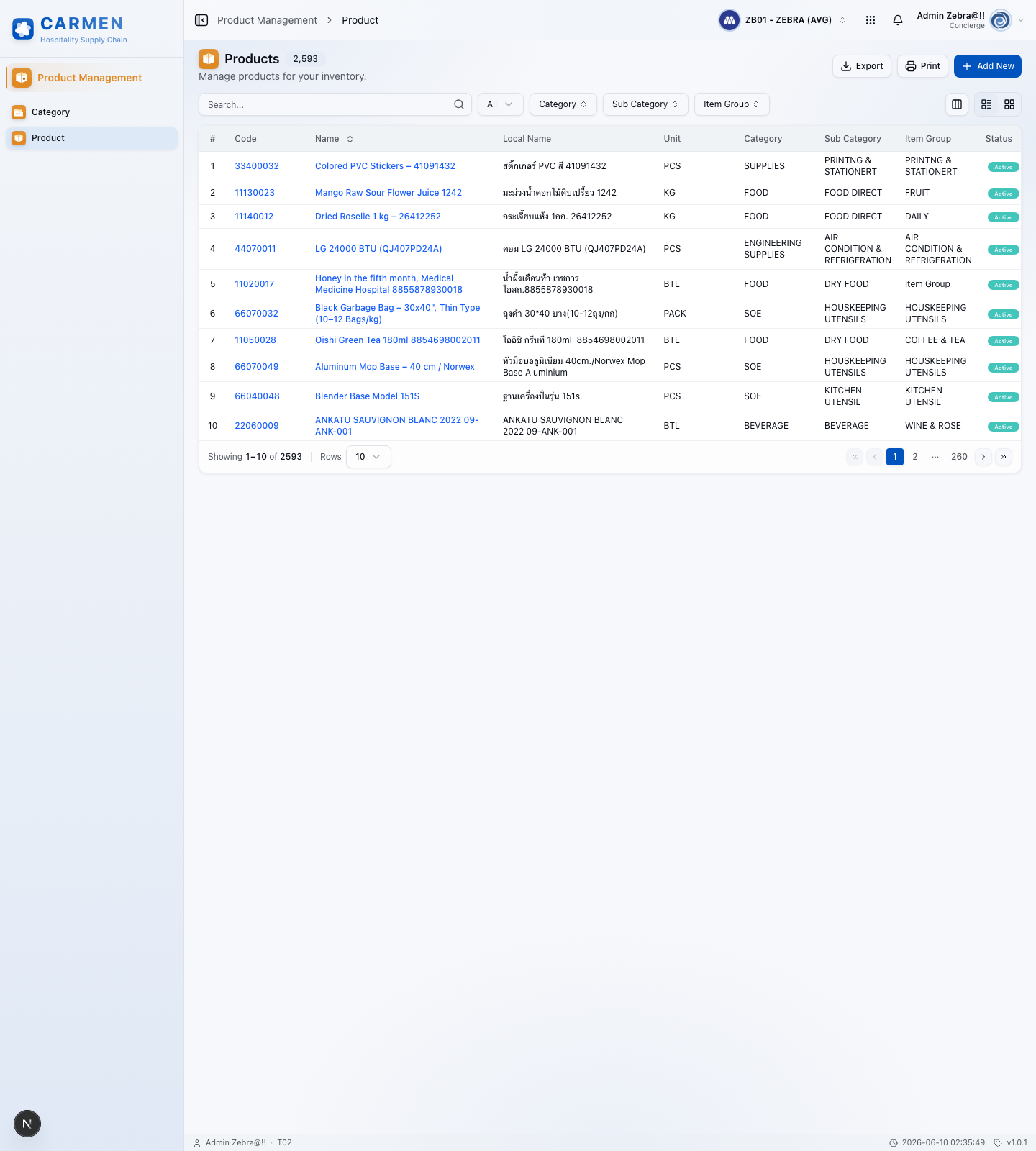
¶ 1. Overview
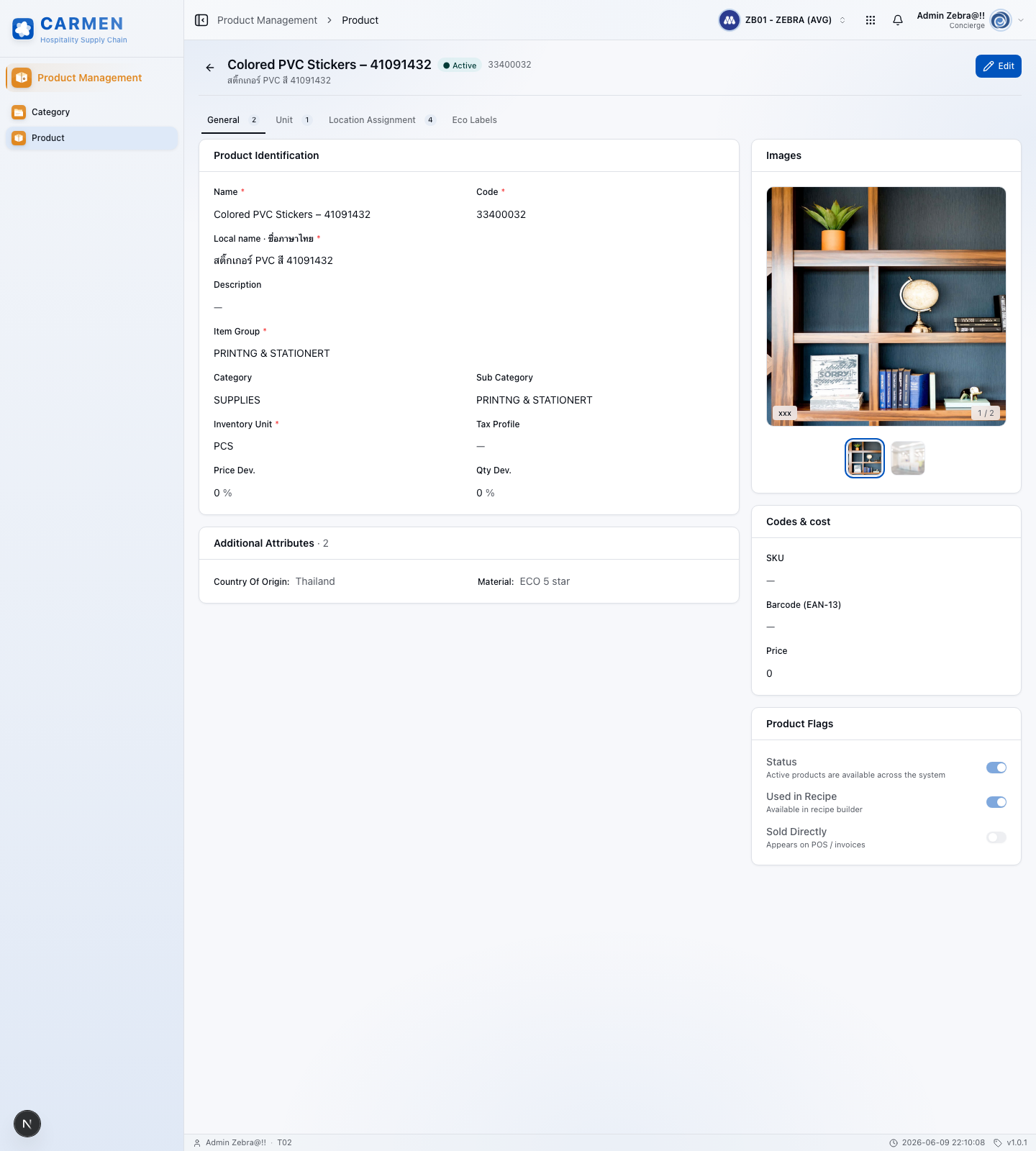
The Product module is the central master-data catalogue for the ERP. Every product is identified by a unique productCode, classified through a category → sub-category → item group hierarchy (up to five levels deep), and carries the descriptive, costing, taxation, and packaging attributes that downstream modules consume. English and local-language descriptions, barcode, standard cost, last receiving cost, and quantity/price deviation tolerances live on the product header; extended attributes (weight, shelf life, storage instructions, size, color, allergens, sustainability data) are modelled as typed key-value pairs that can be inherited from the category and overridden at the product level.
A product is measured in a base inventory unit with one or more order units and recipe units layered on top via explicit conversion factors. The conversion table is validated for consistency (bidirectional, non-circular) so that a quantity entered in any unit on any document — PR, PO, GRN, requisition, recipe — can be resolved back to the base unit for valuation. Every product is also activated against one or more storage locations, with per-location minimum and maximum thresholds that drive replenishment and the level-check logic in inventory.
Bulk maintenance is a first-class concern. Import/export workflows accept Excel and CSV payloads for products, categories, units, and conversion factors with row-level validation, dry-run preview, and a downloadable error report; barcodes, QR codes, and category templates support bulk generation. The combination of validated master data and bulk tooling is what lets new properties and new menu launches go live without one-off entry per item.
¶ 2. Business Context
Product master is the foundation every other module reads from. A purchase request line, a PO line, a GRN line, a requisition line, a recipe ingredient, a stock balance, a costing record — none of them exist independently of a product. Bad master data corrupts everything downstream: the wrong base unit silently inflates or deflates valuation, a missing conversion factor blocks receiving, a stale category breaks reporting roll-ups, an inactive product still attached to an open recipe causes orders to fail. Hospitality groups operating across multiple properties feel this acutely — a single global product list with property-level location enablement is what keeps the chain consistent while local kitchens stay flexible.
This module is therefore the system of record for the definition of an item, not its movements or balances. It feeds product identity and structure to inventory, vendor-pricelist, purchase-request, purchase-order, and recipe, and consumes nothing back from them except usage flags (e.g., "in-use" prevents delete). Getting this layer right — codes, units, categories, locations, allergens — is the precondition for every other module functioning correctly.
¶ 3. Key Concepts
- Product Category: A hierarchical classification node (category → sub-category → item group, up to five levels) used for organisation, reporting roll-ups, and attribute inheritance. Categories can carry required attributes, default values, and business rules that propagate to every product assigned beneath them. Deletion is blocked while any product is still assigned.
- Base Unit: The canonical inventory unit of measure for a product (e.g.,
KG,LITRE,EACH). All stock balances, costs, and valuations are stored in the base unit; every other unit attached to the product is defined relative to it via a conversion factor. - Conversion Factor: The multiplier that translates a quantity expressed in an order unit or recipe unit into the base unit (e.g., 1
CASE= 12EACH). Conversions are validated for bidirectional consistency, must avoid cycles, and propagate to PR/PO/GRN/recipe lines so the system can always resolve the same physical quantity regardless of how it is entered. - Location Mapping: The assignment of a product to one or more storage locations (warehouses, stores, kitchens), each with optional minimum and maximum quantity thresholds. Only locations a product is mapped to can hold a balance for that product; the mapping also drives par-level alerts and replenishment suggestions.
- Active/Inactive: The lifecycle flag controlling whether a product can appear on new documents. Inactive products retain their history (balances, past POs, past recipes) but are excluded from pickers and from new transactions; the status transition is auditable and can be scheduled to take effect on a future date.
- Barcode: A scannable identifier (UPC, EAN, CODE128, QR) attached to a product or product variant. Barcodes must be unique, can be generated in bulk, are printable as labels, and are the primary lookup key for mobile receiving, picking, counting, and spot-check workflows.
- Allergen: A regulated attribute flagging the presence of allergens (gluten, dairy, nuts, shellfish, etc.) in a product. Allergen data is set on the product, inherited through recipes to the menu item, and surfaced to F&B Operations for guest disclosure and to Procurement when sourcing substitutes.
- Product Variant: A specific version of a product distinguished by attribute combinations (size, color, packaging) with its own SKU, optional pricing/costing overrides, and inventory tracking. Variants share the parent product's category and base unit but can carry variant-specific media and sustainability data.
- Standard Cost / Last Receiving Cost: The reference costs carried on the product header. Standard cost is the planned/budgeted cost used for variance analysis; last receiving cost is the most recent actual unit cost observed on a GRN, displayed alongside the date and vendor for context. Neither replaces the moving valuation maintained by the costing module.
- Quantity / Price Deviation Tolerance: Per-product percentage tolerances (0–100%) that bound how far a downstream document line (PR, PO, GRN) may diverge from the master quantity or price before approval is required. The tolerances trickle down to child records and act as guard-rails against entry errors.
- Import/Export: A bulk-load and bulk-extract workflow for products, categories, units, and conversion factors. Imports run row-level validation, support dry-run preview, and emit a downloadable error report; exports support multiple formats and respect the user's saved view and filters.
¶ 4. Roles and Personas
| Role | Responsibility |
|---|---|
| Product Administrator | Owns the catalogue: creates and maintains products, categories, sub-categories, item groups, and units; configures conversion factors, attributes, and location mappings; runs imports/exports and manages product lifecycle (activation, deprecation, deletion). |
| Purchaser | Looks up products to compose PRs and POs, references standard and last receiving costs, verifies order-unit conversions and vendor mappings, and flags missing or stale catalogue entries back to the administrator. |
| Store Keeper | Looks up products during receiving, picking, transfers, and counts; scans barcodes for fast identification; references location thresholds and per-product handling notes (storage instructions, shelf life). |
¶ 5. Related Modules
Cross-module flow:
- inventory — every inventory balance is keyed by product
- vendor-pricelist — pricelists reference products
- purchase-request — PR lines reference products
- purchase-order — PO lines reference products
- recipe — recipes reference products as ingredients
Master configuration:
- master-data/unit — base, order, and recipe units of measure plus conversion factors
- system-config/application-config — tenant-level defaults (deviation tolerances, barcode policy, attribute schema)
- reporting-audit/activity — product lifecycle and bulk-import activity log for audit
- reporting-audit/attachment — product images, spec sheets, and certificates attached to each product
¶ 6. Reference Sources
- Concepts:
../carmen/docs/product-management/ - Frontend:
../carmen-inventory-frontend/ - Backend:
../carmen-turborepo-backend-v2/ - API contracts:
../carmen-turborepo-backend-bruno/ - E2E tests:
../carmen-inventory-frontend-e2e/
¶ 7. Pages in This Module
- 01 — Data Model — Entities, fields, relationships, and enums (Prisma-derived).
- 02 — Business Rules — Validation, calculation / inheritance, authorization, lifecycle, and cross-module rules.
- 03 — User Flow — Product record lifecycle, plus persona index.
- 04 — Test Scenarios — Persona scope, cross-persona scenarios, E2E mapping.